
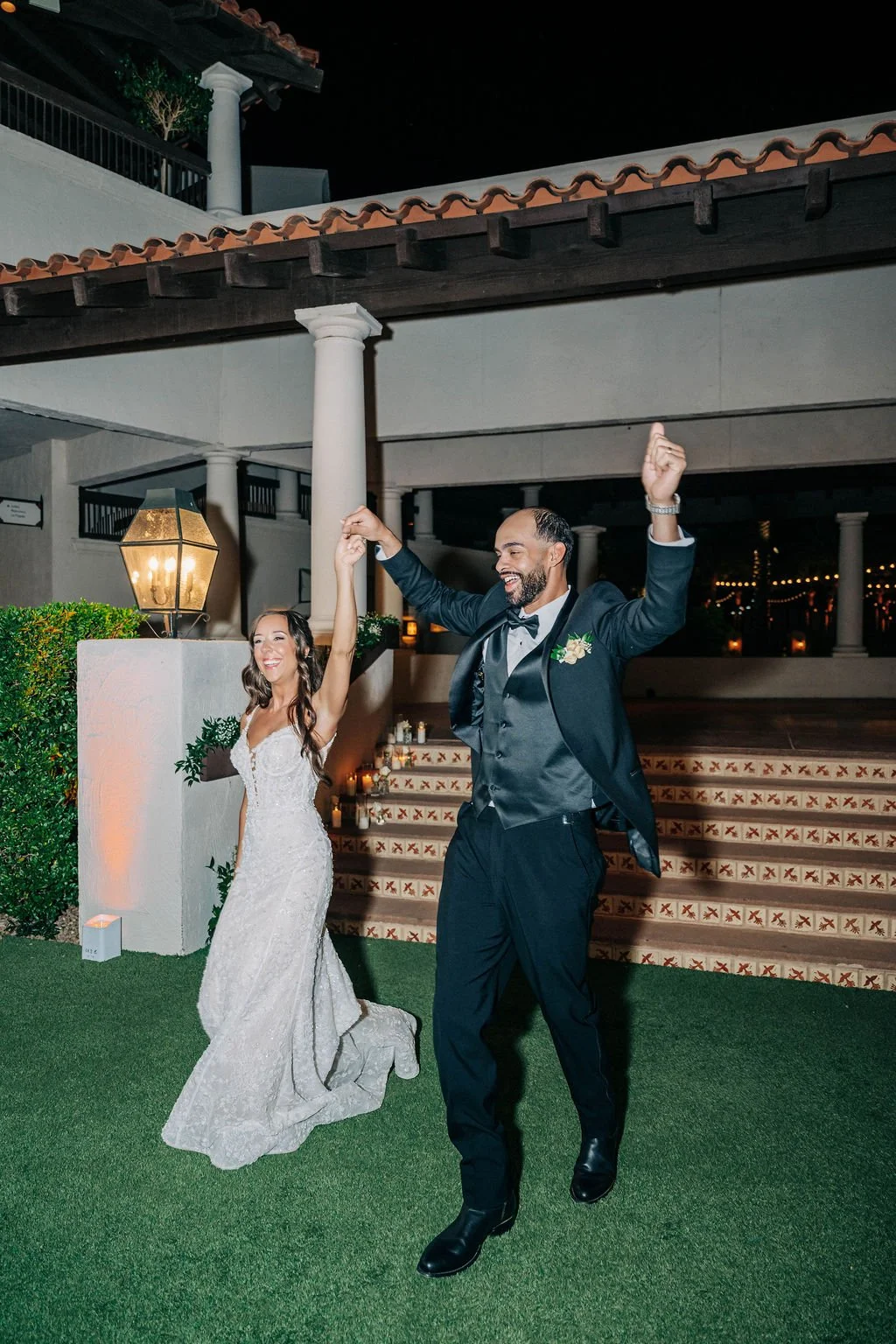
There is a moment, right before the doors open, when the room holds its breath.
Guests are already on their feet. The music is building. The wedding party is lined up just outside, laughing and nervous and ready. And somewhere between that held breath and the moment the couple walks through — the reception either ignites or it does not.
The grand entrance is the most high-stakes sixty seconds of the entire night.
Get it right, and you have a warm, electric room that carries that energy for the next four hours. Get it wrong, and you spend the rest of the evening trying to recover something that never quite found its footing.
Most couples know this instinctively. That is why they spend so much time choosing the entrance song. But the song is only one part of what makes a grand entrance actually land.
The Grand Entrance Is Not Just an Introduction
Here is what most people do not realize about the grand entrance: it is not just a logistical transition from cocktail hour to reception.
It is the emotional ignition point of the night.
Everything that happens in the four hours after it — the dancing, the toasts, the energy on the floor, how quickly guests warm up — is shaped by what happens in that room during those first few minutes. A grand entrance that lands sends a clear message to every guest: tonight is going to be good.
It gives people permission to let go.
Before the entrance, guests are still in cocktail hour mode — standing, socializing, keeping things polished. The grand entrance is the signal that the evening has shifted. That it is time to celebrate, not just attend.
When that signal is strong, the room responds immediately. When it is weak or awkward or mistimed, guests settle back into their seats and wait for something to move them — and that wait can take the better part of an hour.
Song Selection Is Only Half of the Decision
Song choice matters. Of course it does.
The right entrance song matches the couple's energy, fits the feel of the room, and gives the wedding party something to move to. The wrong one — too slow, too obscure, too disconnected from what the room is actually feeling — creates a flatness that is hard to shake.
But in more than thirty years of doing this, I have seen the right song land flat and the unexpected song ignite a room, and the difference almost never came down to the track itself.
It came down to timing, setup, and delivery.
The same song, played at the wrong moment — before the room is warm, before guests are actually on their feet, before there is enough energy in the space to receive it — will not land the way it should. That song that worked perfectly at your friend's wedding might not do the same thing at yours, in a different ballroom, with a different crowd, at a different point in the evening.
What the song needs in order to work is context. And context is built before the music even starts.
The Moment Before the Moment
The sixty seconds leading into the grand entrance matter as much as the entrance itself.
This is where the MC earns their presence.
A skilled MC is not just reading names off a list. They are managing the room's energy — building anticipation, getting guests to their feet, setting the emotional tone for what is about to happen. They are reading how warm the room already is and deciding how much runway the entrance needs.
Some rooms are ready the moment cocktail hour ends. The energy is already high, guests are loose, and the entrance can come in fast and hit hard. Other rooms need a beat — a little more warmup, a slightly longer build — before they are positioned to receive the moment.
The MC reads that and adjusts.
Done well, by the time the doors open and the first member of the wedding party walks through, the room is not just watching. They are already invested. They are already giving.
That is the difference between an entrance being witnessed and an entrance being felt.
What the Wedding Party Brings Into the Room
Here is something couples sometimes overlook: the energy of the wedding party sets the energy of the room.
Guests take their cue from the people walking through those doors. If the bridesmaids are genuinely having fun, dancing their way in, laughing and celebrating — the room follows. If the groomsmen are stiff and self-conscious, moving awkwardly to a song they are not connected to — the room feels that too.
This is why working through the entrance in advance matters. Not just choosing the song, but knowing who is walking in to what, understanding the order, making sure each person knows their cue and has a moment to actually enjoy it.
When I work with couples ahead of the reception — whether that is through the planning process or at the rehearsal the evening before — we talk through the entrance in detail. What song is playing for the wedding party. What the couple is walking in to. What happens in the transition between the two. Where the mic work lives and where it steps back.
The goal is that by the time the wedding party is lined up outside that door, they feel ready — not just instructed.
When It Lands Versus When It Does Not
I have been in rooms where the grand entrance hit so hard that guests did not sit back down for ten minutes. The couple walked through and the room erupted — not just polite applause, but genuine celebration. People screaming, rushing toward them, phones in the air. That energy went straight into the first dance and never really let go.
I have also been in rooms where the entrance never quite found its moment. The music started before everyone was on their feet. The MC rushed the introductions. The couple walked in to a room that was still settling. And you could feel the flatness — the slight deflation of a moment that did not land the way it was supposed to.
The difference, most of the time, was not the song. It was the setup.
What to Look for When You Are Planning Yours
If you are in the planning process for a Phoenix or Scottsdale wedding and trying to figure out what to prioritize around the grand entrance, here is the honest answer: the song matters less than you think, and the execution matters more.
Think about how you want the room to feel when you walk in — not which track is playing, but what emotion you want to hit the room with. Do you want electric and celebratory? Warm and emotional? Big and anthemic? That feeling is the brief. The right song comes out of that clarity, not the other way around.
Think about your wedding party and what they are actually going to do when they walk through that door. A song choice that requires performance from people who are going to freeze up does not serve the moment. A simpler song that gives everyone room to just be themselves and celebrate often works better.
And think about who is behind the mic and how well they understand the room you are walking into. The MC's job during the grand entrance is to set you up — to make sure that by the time you walk through, the room is already giving. If the person on the mic is just reading names, that is not the same thing.
The Night Remembers Its Opening
Receptions have a memory. The way a night starts shapes how guests feel about it hours later, even after they have forgotten most of the specific details.
Couples who had a grand entrance that hit — who felt the room react the way they hoped it would — walk into their first dance with a confidence that carries through the rest of the evening. Their guests are already warmed up, already invested, already happy they came.
That is not something you recover easily if the entrance misses. But when it lands, you spend the rest of the night building on something that is already working.
The grand entrance is sixty seconds. The room it creates lasts the whole night.
DJ Nate Murray is a wedding DJ and MC serving Phoenix, Scottsdale, Paradise Valley, and Southern California. For availability, click here.