
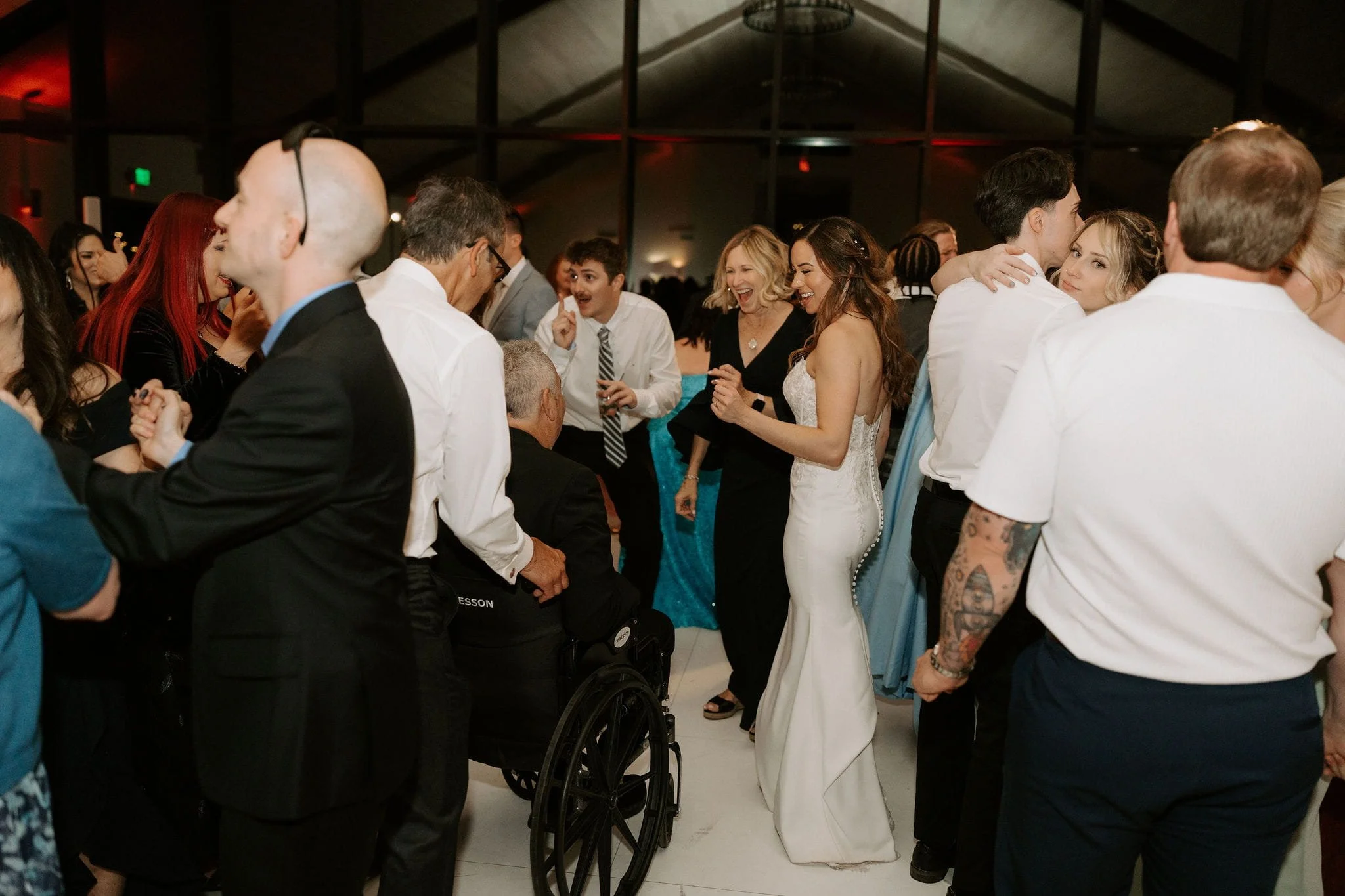
You've got your college friends coming. Your parents and their friends. Cousins you grew up with. Maybe family flying in from different parts of the country, each bringing their own musical tastes and traditions.
And somehow, you're supposed to throw one party that brings everybody together.
So naturally, you start wondering:
How do we make sure there's music for everyone without turning our wedding reception into a bunch of different playlists?
It's a good question. And it's one I think about quite a bit.
Here's what I've learned: You don't need every guest to love every song. You need the music to give different people opportunities to connect, without constantly interrupting the party.
That's a different challenge. And it's one of my favorite parts of DJing weddings.
The Problem With Trying to Play Something for Everyone
I've never been a fan of treating a wedding reception like a musical checklist.
Three old-school songs for the parents. Three current hits for the younger crowd. A little Latin music. A little country. Some hip-hop. Then repeat until the night's over.
On paper, everybody gets something.
But music doesn't work that way.
Imagine a dance floor that's finally moving. People are singing, laughing, grabbing friends from their tables and bringing them out to join the party.
Then the entire musical direction changes.
Some people stay. Others wander off. A few minutes later, a different group comes out, and the whole process starts over.
Nothing is necessarily wrong with the individual songs. The problem is that the party keeps restarting.
A great wedding DJ has to think beyond which songs people like and consider how those songs work together.
The goal isn't to create separate parties for each age group. It's to help your guests enjoy the same celebration.
Age Doesn't Tell Me Nearly Enough About Your Guests
One of the easiest mistakes to make is assuming someone's age tells you what music they enjoy.
It doesn't.
I've met people who grew up with classic soul but love current hip-hop. I've met younger people who know every word to an Earth, Wind & Fire record. Some guests love Latin music because it's part of their upbringing. Others discovered it through friends, travel, or simply because they enjoy dancing to it.
Musical taste is personal.
That's why I want to know more about your guests than how many people fall into each age bracket.
What do your families enjoy together? Which friends are always the first on the dance floor? Are there songs everybody knows because they've been part of family celebrations for years?
And who are the people who probably won't start dancing until they hear something that feels familiar?
Those details tell me much more than a demographic breakdown.
They're clues about how to bring people together.
The Right Song Can Connect People Who Grew Up Decades Apart
Here's something I love about music.
A great record doesn't always belong to one generation.
Take a song like "Let's Groove" by Earth, Wind & Fire.
Sure, it came out in 1981. But that doesn't mean the only people who respond to it were around when it was released.
That groove has lived through decades of parties, family gatherings, radio, movies, and DJ sets.
Now think about Beyoncé's "CUFF IT."
Different era. Different artist. But there's a familiar funk and disco influence that gives the music a connection.
I'm not saying those two songs should always be played together. They shouldn't. It depends on the people in front of you.
But they're an example of how I think about music.
Sometimes a familiar groove can connect one generation's favorite record to another generation's favorite record.
Sometimes it's the chorus everybody recognizes. Sometimes it's the rhythm. Sometimes there's a shared musical influence that makes a transition feel natural even though the songs were released decades apart.
That's much more interesting to me than simply sorting songs by decade.
I'm looking for what the music has in common, because sometimes that's where the people find common ground too.
Keeping the Dance Floor Together Requires More Than Good Song Selection
Let's say we're into the dancing portion of the reception.
A particular stretch of music is working. People are staying on the floor, and more guests are joining.
What do I do next?
First, I pay attention.
Are people actually dancing, or just standing together singing? Is that a bad thing? Not necessarily. Some of the best party moments happen when everybody knows the words.
Are guests responding to the groove, the artist, or the familiarity of the song?
Is one group starting to dominate while the rest of the room is losing interest?
And most importantly, is the couple enjoying themselves?
Those things influence what comes next.
Sometimes I stay in the same musical lane because there's no reason to interrupt something that's working.
Sometimes I introduce a record that feels familiar to a different group while keeping the momentum going.
And sometimes the right decision is to change direction completely.
What I don't want to do is make those decisions simply because the next song happens to be on a predetermined list.
That's the difference between following a playlist and actually DJing a party.
Not Every Musical Transition Needs to Be Dramatic
There's a lot of attention given to DJ transitions, especially when people talk about mixing different genres.
But the goal isn't to show off how quickly I can move from one style to another.
The goal is to make the next song feel right.
That might mean keeping a similar groove while changing artists.
It might mean moving from something soulful into a more current record.
Or it might mean recognizing that a particular chorus is exactly what the guests need at that moment.
Other times, a bigger change is appropriate. Maybe a group of friends has been waiting for a particular musical direction, and the room is ready to go there.
The skill is in knowing when to make that move.
A sudden musical change can create an incredible reaction when the timing is right. Make that same change at the wrong moment, and you can lose the connection you've spent the last twenty minutes building.
That's why I don't believe in playing every style equally.
I believe in giving the music a direction while making sure the people who matter to you have opportunities to be part of it.
Your Family's Traditions Deserve More Than a Token Song
When couples and their families come from different cultural backgrounds, the music conversation becomes even more interesting.
There might be particular songs that bring relatives together. Maybe a traditional dance is part of the reception. Perhaps a certain artist or style has been part of family celebrations for generations.
I want to understand those things.
But I don't want to make assumptions about anyone's musical taste based on their name, background, or where their family comes from.
If there's a tradition you want to honor, I want to know what it means to you and how you'd like it included.
Is it a moment when family members are invited to dance?
Is it something everyone recognizes from home?
Does it have a specific place in the evening?
Should it be introduced, or would it feel more natural to let the music speak for itself?
Those details matter.
And if a specific dance or performance requires coordination, that's something I'll work through with you and your planner before the wedding.
The point isn't to check a cultural box.
It's to recognize the people, relationships, and traditions that are meaningful to you.
When that's done thoughtfully, those moments can become some of the most enjoyable parts of the entire celebration.
One of My Favorite Reviews Says It Better Than I Can
A couple I worked with, Rosalinda and her partner, had a family with different musical tastes.
In her review, Rosalinda wrote:
"I have a very mixed family and yet he was able to please the entire crowd."
I appreciate that because it gets to the heart of what I want couples to experience.
It isn't about proving that I can play every genre.
It's about helping the people you brought together enjoy the celebration.
Rosalinda also mentioned my personality and sense of humor, which made me smile.
That's part of the experience too.
A wedding shouldn't feel like a carefully monitored music experiment. It should feel like a party, with laughter, excitement, and people comfortable enough to have fun.
Sometimes the best way to bring people together isn't another carefully calculated song. It's creating the kind of atmosphere where people want to join in.
What About Guests Who Don't Dance?
Here's another thing worth remembering.
Not everybody has to be on the dance floor for the reception to be successful.
Some people are happiest catching up with family. Some enjoy watching everyone else dance. Others might join for one favorite song and spend the rest of the evening enjoying the celebration from their seats.
That's perfectly fine.
I don't want your reception to feel like an attendance contest where every guest is expected to dance.
I want the music to make the entire room enjoyable.
That starts before the dance floor opens.
Cocktail hour and dinner are opportunities to create an atmosphere where people feel comfortable, recognize the personality of the celebration, and enjoy being together.
Then, when it's time to dance, the music can move in a different direction.
Some guests will stay seated. Others will dance all night.
And sometimes the person who said they weren't going to dance is suddenly in the middle of the floor.
You never know.
That's part of what makes a live celebration fun.
What I Want to Know Before Your Wedding
When we talk about music, I absolutely want to know what you love.
But I also want to understand who's going to be there.
Tell me about the friends who have known you forever.
Tell me about the relatives who love a good party.
Tell me about the songs that bring your families together, the music you grew up with, and any traditions you want to celebrate.
We'll talk about what you definitely want to hear, what you don't want played, and the kind of party you're hoping for.
Then I'll use that understanding to make decisions throughout the reception.
Because no matter how much we prepare, there will always be things we can't know until everybody is together.
We can't predict which song will have your college friends singing at the top of their lungs.
We can't know exactly when your parents will decide to join the dance floor.
And we can't predict every unexpected reaction that makes a great party feel alive.
That's why the planning matters—and why experience during the event matters just as much.
Your Wedding Should Sound Like You and Feel Welcoming to Your Guests
Your wedding isn't supposed to be a tribute to everybody else's favorite music.
It's your celebration.
The music should reflect your taste, your personalities, and the people you've chosen to share it with.
At the same time, part of the fun is watching your guests connect in ways you didn't necessarily expect.
Your parents dancing with your friends. Cousins from different sides of the family celebrating together. Somebody discovering a song they haven't heard in years.
Those are the moments I enjoy seeing.
Not because I managed to play something for every demographic.
Because for a little while, everyone is simply enjoying the same party.
And you get to be right there enjoying it with them.
If you're planning a wedding in Los Angeles, Phoenix, Scottsdale, or beyond, I'd love to hear about the people you're bringing together and the kind of celebration you have in mind.
Let's Talk About Your Wedding — Book a Call
Nate Murray | DJ Nate Murray Weddings & Events